
MIBIscope™
A SIMS-Based Spatial Proteomics Platform
Quantitative spatial proteomics engineered for consistent signal performance across experiments, instruments, and research sites.
Why MIBIscope™
Mass-based detection delivers precise, overlap-free biomarker measurement in preserved tissue, enabling confident spatial biology.

High-Plex Quantitative Imaging
- 40 + metal tagged targets measured simultaneously
- Discrete mass channels eliminate spectral overlap
- Single-step staining workflow
- No compensation or channel bleed-through
Spatial Resolution: ~300–560 nm
A focused primary ion beam enables precise measurement of protein localization within cellular and subcellular structures.
Secondary Ion Mass Spectrometry (SIMS)
A mass spectrometry imaging modality that detects metal-tagged targets at subcellular resolution while preserving tissue architecture.
High-Plex Quantitative Imaging
Simultaneous quantification of 40+ metal-tagged targets in a single tissue section.
Mass-Based Detection Enables Discrete Channel Separation
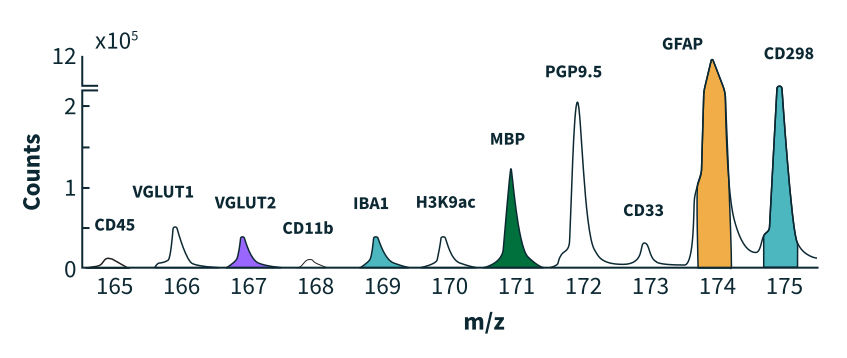
Adapted from Keren et al., Science Advances 2019
The MIBIscope™ uses mass-based detection rather than optical emission.
Each metal isotope tag occupies a discrete mass channel separated by one atomic mass unit (amu). Sub-amu mass resolution enables simultaneous quantitative measurements of dozens of targets without spectral overlap or signal bleed-through.
High Quantitative Reproducibility
Quantitative reproducibility is essential for reliable spatial proteomic measurements across experiments, instruments, and research sites.
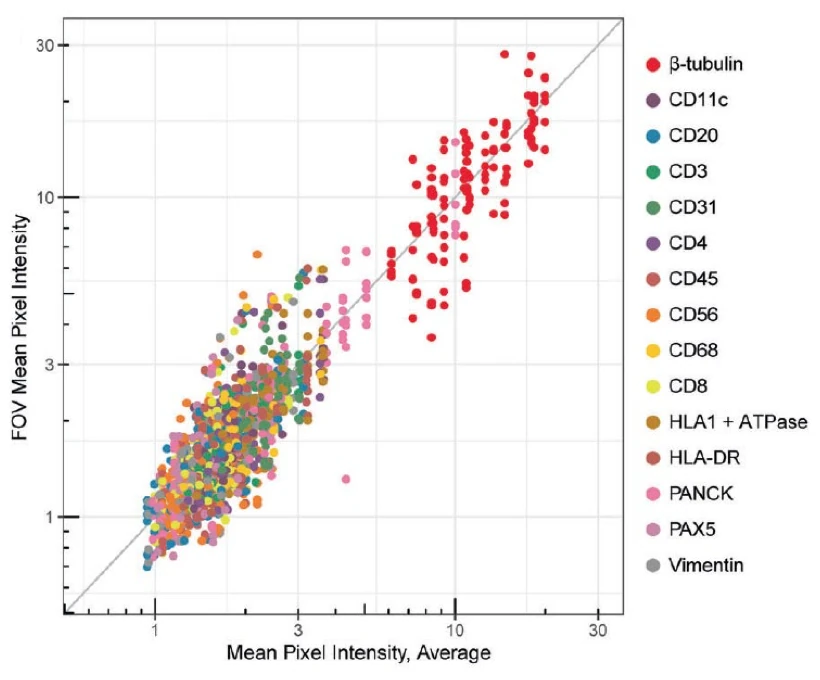
Correlation of mean pixel intensity across serial tissue sections demonstrating quantitative reproducibility across multiplex biomarkers. Adapted from Liu et al., Laboratory Investigation (2022)
Multiplexed ion beam imaging demonstrates strong concordance of signal intensity across serial tissue sections and biomarkers, with mean pixel intensity correlations approaching an R2 = 0.94. Stable detection across markers and fields of view supports consistent quantitative measurement across experiments.
Ion Beam and Detection Architecture
The MIBIscope™ platform integrates a focused primary ion beam with time-of-flight mass detection to enable spatially resolved, high-dimensional imaging of labeled tissue.

Interior of MIBIscope™ imaging chamber showing the primary ion column positioned above the sample stage.
Detection System
Engineered for Quantitative Stability
- Controlled extraction fields ensure efficient secondary-ion collection.
- Stable mass calibration preserves sub-amu peak separation across imaging runs.
Precision Ion Beam Architecture
- Focused primary ion beam enables controlled, high-spatial-resolution tissue ablation.
- Stable beam current maintains consistent ablation volume across imaging runs and ensures reliable multiplexed signal detection.
- Optimized secondary-ion extraction geometry improves ion transfer efficiency and quantitative signal recovery.
Quantitative Linearity Across Five Orders of Magnitude
Sub-amu mass resolution supports linear quantification across five orders of magnitude.
- Linear ion-count detection minimizes saturation and preserves signal sensitivity across a wide dynamic range.
- Simultaneous measurement of rare and abundant targets within the same pixel
- Minimal background due to mass-specific ion detection
- Performance validated in peer-reviewed studies (Keren et al., Sci Adv 2019)
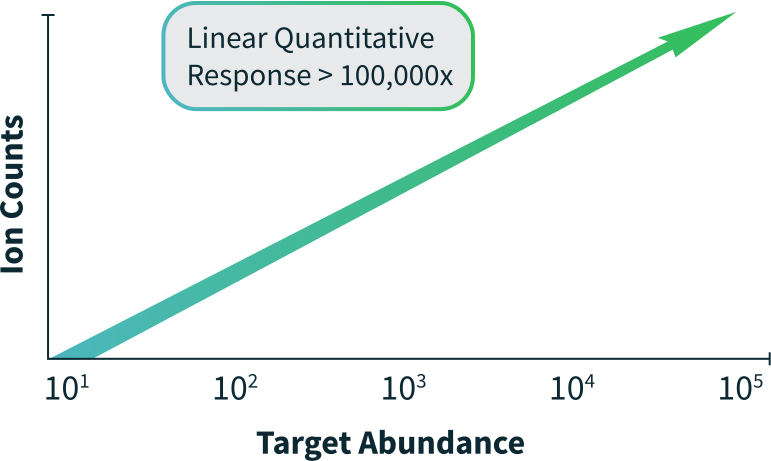
High sensitivity + high dynamic range = robust quantitative imaging
Workflow Designed for Existing Pathology Workflows
Stain Once. Image Anytime.

01
Stable, dried slides enable reproducible QC workflows and longitudinal study design
02
Archived slides can be re-imaged months or years later without signal degradation
03
Slides can be shipped between research sites while preserving quantitative reproducibility
04
Single-step staining eliminates variability associated with cyclic workflows
Demonstrated in Peer-Reviewed Research and Applied Research
Multiplexed Ion Beam Imaging has contributed to a growing number of peer-reviewed studies exploring spatial biology across cancer research, immunology, and tissue architecture. The publications below highlight representative applications demonstrating the capabilities of the MIBIscope™ platform.
Cancer & Tumor Microenvironment
Multi-omic landscape of human gliomas from diagnosis to treatment and recurrence
Piyadasa H, Oberlton B, Ribi M et al.
Cancer Cell | Jan 2026
What was studied:
A longitudinal, multi-omic spatial atlas of gliomas across diagnosis, treatment, and recurrence, analyzing how tumor and immune cell populations evolve within intact tissue over time.
What MIBIscope™ enabled:
High-plex, spatially resolved protein imaging enabled detailed mapping of tumor, immune, and stromal cell interactions, revealing how cellular neighborhoods reorganize during disease progression without signal overlap.
Outcome / impact:
Showed that glioma progression and recurrence are driven by spatial and immune microenvironment remodeling rather than tumor genetics alone, identifying immune-driven patterns linked to patient outcomes and therapeutic resistance.
TNFα-mediated myeloid-instructed CD14⁺CD4⁺ T cells within the tumor microenvironment are associated with poor survival in non-small cell lung cancer
Marceaux C, Tarasova I, Batey D et al.
bioRxiv | Aug 2024
What was studied:
Spatial multi-omics analysis of non-small cell lung cancer identifying a population of myeloid-instructed CD14⁺ CD4⁺ T cells and their role within the tumor microenvironment.
What MIBIscope™ enabled:
In this study, multiplexed ion beam imaging enabled spatial identification of immune cell populations and their proximity relationships, supporting detection of myeloid–T cell interactions and localization of distinct T cell phenotypes within the tumor.
Outcome / impact:
Identified a TNF-driven mechanism where myeloid cells induce aberrant T cell phenotypes via trogocytosis, with high infiltration of CD14⁺ CD4⁺ T cells associated with poor patient survival.
Phase 1 dose expansion and biomarker study assessing first-in-class tumor microenvironment modulator VT1021 in patients with advanced solid tumors
Chen, JJ, Vincent, MY, Shepard, D et al.
Communications Medicine | May 2024
What was studied:
A phase 1 clinical trial evaluating VT1021, a therapeutic designed to reprogram the tumor microenvironment in patients with advanced solid tumors.
What MIBIscope™ enabled:
Multiplexed tissue imaging enables spatial characterization of tumor and immune cell interactions, supporting analysis of how therapies remodel the tumor microenvironment.
Outcome / impact:
VT1021 was shown to be safe and well tolerated, with evidence of tumor microenvironment modulation and early signs of clinical activity, along with identification of potential predictive biomarkers.
A Spatial Multi-Modal Dissection of Host-Microbiome Interactions within the Colitis Tissue Microenvironment
Zhu B, Bai Y, Yeo YY et al.
bioRxiv (preprint) | Mar 2024
What was studied:
Spatial multi-omics analysis of host–microbiome interactions in colitis, examining how immune, epithelial, and microbial components reorganize within the tissue microenvironment.
What MIBIscope™ enabled:
Multiplexed ion beam imaging enables simultaneous spatial mapping of host immune cells and microbial populations, supporting analysis of cellular composition and interaction dynamics in tissue.
Outcome / impact:
Revealed coordinated immune remodeling, microbial shifts, and localized inflammatory responses, providing insight into how disruption of tissue organization drives disease.
Neoadjuvant CD40 Agonism Remodels the Tumor Immune Microenvironment in Locally Advanced Esophageal/Gastroesophageal Junction Cancer
Soto M, Filbert EL, Yang H et al.
Cancer Research Communications | Jan 2024
What was studied:
A clinical study evaluating neoadjuvant CD40 agonist therapy in patients with solid tumors, examining how treatment reshapes the tumor immune microenvironment.
What MIBIscope™ enabled:
In this study, multiplexed spatial imaging enabled detailed characterization of immune cell composition and activation states within tumors, supporting analysis of therapy-induced remodeling of the tumor microenvironment.
Outcome / impact:
CD40 agonism increased antigen presentation, expanded and activated cytotoxic T cells, reduced immunosuppressive populations, and restructured the tumor microenvironment toward a more effective anti-tumor immune response.
Spatial profiling technologies illuminate the tumor microenvironment
Elhanani O, Ben-Uri R, Keren L et al.
Cancer Cell | Mar 2023
What was studied:
Investigation of how interactions between cancer cells and immune cells influence tumor cell states in glioblastoma, particularly transitions toward mesenchymal-like phenotypes associated with disease progression.
What MIBI enabled:
In this study, spatially resolved and single-cell approaches enabled analysis of tumor–immune cell interactions within tissue, supporting identification of how local cellular environments influence tumor cell behavior.
Outcome / impact:
Demonstrated that immune–tumor interactions actively drive phenotypic transitions in cancer cells, linking microenvironmental signaling to tumor aggressiveness and progression.
Dynamic CD8+ T cell responses to cancer immunotherapy in human regional lymph nodes are disrupted in metastatic lymph nodes
Rahim MK, Okholm TLH, Jones KB et al.
Cell | Mar 2023
What was studied:
Spatial analysis of CD8⁺ T cell responses to cancer immunotherapy in human lymph nodes, comparing immune activity in tumor-draining versus metastatic lymph nodes.
What MIBIscope™ enabled:
In this study, multiplexed ion beam imaging enabled spatial mapping of immune cell populations within lymph node architecture, supporting analysis of T cell localization, activation states, and interactions within defined tissue regions.
Outcome / impact:
Revealed that effective immunotherapy responses are associated with organized, spatially structured T cell activity in lymph nodes, while metastatic involvement disrupts these immune dynamics, linking spatial immune organization to therapeutic response.
Molecular classification and biomarkers of clinical outcome in breast ductal carcinoma in situ: Analysis of TBCRC 038 and RAHBT cohorts
Strand SH, Rivero-Gutierrez B, Houlahan KE et al.
Cancer Cell | Dec 2022
What was studied:
Integrated molecular and spatial profiling of ductal carcinoma in situ (DCIS) to understand the biological factors that drive progression to invasive breast cancer.
What MIBI enabled:
In this study, multiplexed imaging enabled spatial characterization of tumor and immune cell populations within pre-invasive lesions, supporting analysis of how cellular composition and organization relate to disease progression.
Outcome / impact:
Identified molecular and microenvironmental features associated with progression risk, linking spatial tumor–immune context to clinical outcomes and enabling improved stratification of patients with DCIS.
Spatial epitope barcoding reveals clonal tumor patch behaviors
Rovira-Clave X, Drainas AP, Jiang S et al.
Cancer Cell | Nov 2022
What was studied:
Development of spatial epitope barcoding to track clonal tumor cell populations and their behavior within the tumor microenvironment.
What MIBIscope™ enabled:
In this study, multiplexed ion beam imaging enabled in situ tracking of barcoded tumor cells, supporting spatial analysis of clonal populations, cell states, and their interactions within tissue.
Outcome / impact:
Revealed that tumor clones form spatially organized patches with distinct growth behaviors, demonstrating that clonal expansion and tumor heterogeneity are shaped by local microenvironmental context.
Single-nucleus and spatial transcriptome profiling of pancreatic cancer identifies multicellular dynamics associated with neoadjuvant treatment
Hwang WL, Jagadeesh KA, Guo JA et al.
Nature Genetics | Aug 2022
Study Focus:
Characterization of cellular composition, tumor subtypes, and treatment response in pancreatic cancer using integrated single-nucleus and spatial profiling.
What MIBIscope™ enabled:
Spatially resolved mapping of cell types and protein expression within intact tumor tissue, enabling integration of cellular states with tissue context.
Outcome / Impact:
Identified distinct multicellular communities and treatment-associated tumor states, including programs linked to poor prognosis, providing a framework for understanding tumor response and guiding therapeutic strategies.
Reproducible, high-dimensional imaging in archival human tissue by multiplexed ion beam imaging by time-of-flight (MIBI-TOF)
Liu C, Bosse M, Kong A et al.
Laboratory Investigation | Jul 2022
What was studied:
Spatial organization of immune cells and tumor-associated macrophages within the tumor microenvironment, with a focus on how cellular neighborhoods influence disease progression and immune response.
What MIBIscope™ enabled:
Multiplexed, spatially resolved protein imaging enabled simultaneous visualization of diverse immune and stromal cell populations within intact tissue, allowing precise mapping of cell–cell interactions and microenvironment structure without signal overlap.
Outcome / impact:
Revealed that specific spatial arrangements of immune cells correlate with disease state and immune activity, highlighting the importance of tissue architecture in understanding tumor biology and informing therapeutic strategies.
Transition to invasive breast cancer is associated with progressive changes in the structure and composition of tumor stroma
Risom T, Glass DR, Averbukh I et al.
Cell | Jan 2022
Study Focus:
Investigation of how the tumor microenvironment evolves during progression from pre-invasive to invasive breast cancer.
What MIBI Enabled:
High-dimensional spatial imaging of protein markers in intact tissue, enabling mapping of epithelial, stromal, and immune cell organization during disease progression.
Outcome / Impact:
Revealed that transition to invasive cancer is driven by coordinated spatial reorganization of multiple cell types, providing a framework for understanding tumor progression and identifying new intervention points.
Signatures of plasticity, metastasis, and immunosuppression in an atlas of human small cell lung cancer
Chan JM, Quintanal-Villalonga A, Gao VR et al.
Cancer Cell | Nov 2021
Study Focus:
Characterization of tumor heterogeneity, plasticity, and immune microenvironment interactions in small cell lung cancer.
What MIBI Enabled:
Integration of spatial proteomic imaging with single-cell transcriptomic data to map tumor subpopulations and their microenvironment in situ.
Outcome / Impact:
Identified a stem-like, pro-metastatic tumor subpopulation associated with immune suppression and poor prognosis, providing insight into mechanisms of disease progression and therapeutic resistance.
Multimodal Analysis of Composition and Spatial Architecture in Human Squamous Cell Carcinoma
Ji AL, Rubin AJ, Thrane K et al.
Cell | Jul 2020
Study Focus:
Integrated analysis of cellular composition and spatial organization in human squamous cell carcinoma.
What MIBI Enabled:
Spatially resolved protein imaging combined with single-cell transcriptomics to map tumor, immune, and stromal cell interactions within intact tissue.
Outcome / Impact:
Revealed coordinated cellular ecosystems and spatial organization underlying tumor behavior, providing a framework for understanding tumor–immune interactions and therapeutic targeting.
A Structured Tumor-Immune Microenvironment in Triple Negative Breast Cancer Revealed by Multiplexed Ion Beam Imaging
Keren L, Bosse M, Marquez D et al.
Cell | Sep 2018
Study Focus:
Characterization of spatial organization and cellular composition in human breast tumors.
What MIBI Enabled:
High-dimensional imaging of dozens of protein markers within intact tumor tissue, enabling mapping of tumor, immune, and stromal cell interactions.
Outcome / Impact:
Identified distinct spatially organized cellular neighborhoods associated with tumor biology, establishing a framework for spatial analysis of cancer.
Immune & Inflammatory Biology
A Hitchhiker’s guide to high-dimensional tissue imaging with multiplexed ion beam imaging
Yeo YY, Cramer P, Deisher A et al.
Methods in Cell Biology | Mar 2024
What was studied:
Overview of highly multiplexed tissue imaging approaches applied to immunology, highlighting how spatial profiling enables characterization of immune cell composition and function within complex tissue environments.
What MIBIscope™ enabled:
High-plex spatial imaging enables simultaneous measurement of multiple immune markers at single-cell resolution, supporting analysis of immune cell states, localization, and interactions within intact tissue.
Outcome / impact:
Establishes multiplexed imaging as a key approach for understanding immune system organization and function in situ, with applications across disease biology and translational research.
Single-cell spatial proteomic imaging for human neuropathology
Vijayaragavan K, Cannon BJ, Tebaykin D et al.
Acta Neuropathologica Communications | Nov 2022
Study Focus:
Characterization of cellular states and microenvironment organization in human brain tissue across normal aging and neurodegenerative disease.
What MIBI Enabled:
Simultaneous imaging of ~30+ protein markers in intact human brain tissue with spatial resolution, enabling in situ mapping of cellular phenotypes and interactions.
Outcome / Impact:
Identified distinct microglial states and spatial patterns associated with neurodegeneration, providing a new framework for understanding brain pathology in human disease.
Combined protein and nucleic acid imaging reveals virus-dependent B cell and macrophage immunosuppression of tissue microenvironments
Jiang S, Chan CN, Rovira-Clave X et al.
Immunity | Jun 2022
Study Focus:
Investigation of how viral infection reshapes immune cell behavior and spatial organization within tissue microenvironments.
What MIBIscope™ enabled:
Integrated spatial imaging of protein expression and nucleic acid signals within intact tissue, enabling simultaneous mapping of immune cell states, interactions, and infection status.
Outcome / Impact:
Identified virus-dependent immunosuppressive interactions between B cells and macrophages, revealing how local immune environments are reprogrammed during infection.
Multiplexed imaging reveals an IFN-γ-driven inflammatory state in nivolumab-associated gastritis
Ferrian S, Liu CC, McCaffrey EF et al.
Cell Reports Medicine | Oct 2021
Study Focus:
Investigation of immune-mediated tissue damage associated with checkpoint inhibitor therapy in human gastric tissue.
What MIBI Enabled:
Spatially resolved imaging of immune cell populations and cytokine signaling within intact tissue, enabling identification of functional immune states and interactions.
Outcome / Impact:
Identified an IFN-γ–driven inflammatory program involving T cells and macrophages, providing insight into mechanisms of immunotherapy-related toxicity and immune dysregulation.
High Throughput Multi-Omics Approaches for Clinical Trial Evaluation and Drug Discovery
Zielinski JM, Luke JJ, Guglietta S et al.
Frontiers in Immunology | Mar 2021
What was studied:
Review of multi-omics technologies and their application to understanding immune biology and evaluating therapeutic responses, with emphasis on integrating molecular and cellular data across biological systems.
What MIBIscope™ enabled:
High-plex spatial imaging enables integration of protein-level data with tissue context, supporting characterization of immune cell phenotypes and their interactions within complex tissue environments.
Outcome / impact:
Highlights the importance of integrating multi-modal biological data to better understand immune responses and improve drug development and clinical evaluation strategies.
Tissue Architecture
High-plex imaging and cellular neighborhood spatial analysis reveals multiple immune escape and suppression patterns in diffuse large B-cell lymphoma
Reiss DJ, Nakayama Y, Weng AP et al.
Leukemia | Apr 2024
What was studied:
Spatial organization of tumor and immune cells in diffuse large B-cell lymphoma, focusing on how cellular neighborhoods within the tumor microenvironment relate to disease biology.
What MIBIscope™ enabled:
In this study, high-plex spatial imaging enabled identification and quantification of distinct cellular neighborhood clusters, supporting analysis of spatial relationships between tumor and immune cells within the microenvironment.
Outcome / impact:
Identified multiple spatial patterns of immune suppression and escape, linking tumor–immune organization to underlying disease mechanisms and potential clinical outcomes.
Diffuse large B-cell lymphomas have spatially defined, tumor immune microenvironments revealed by high-parameter imaging
Wright KT, Weirather JL, Jiang S et al.
Blood Advances | Aug 2023
What was studied:
Spatial profiling of diffuse large B-cell lymphoma (DLBCL) to characterize how tumor and immune cells are organized within the tumor immune microenvironment.
What MIBIscope™ enabled:
In this study, high-parameter multiplexed imaging enabled single-cell spatial mapping of tumor and immune populations, supporting identification of distinct cellular neighborhoods and their spatial organization within tissue.
Outcome / impact:
Identified structured cellular neighborhoods that define distinct tumor immune microenvironments, demonstrating that spatial organization—not just cell composition—drives functional differences in lymphoma biology.
The immunoregulatory landscape of human tuberculosis granulomas
McCaffrey EF, Donato M, Keren L et al.
Nature Immunology | Jan 2022
Study Focus:
Characterization of spatial organization and immune regulation within human tuberculosis granulomas.
What MIBI Enabled:
High-dimensional imaging of ~30+ protein markers in intact tissue, enabling mapping of immune cell types and spatial microenvironments within granulomas.
Outcome / Impact:
Identified distinct, spatially localized immunosuppressive microenvironments, revealing how tissue structure governs immune function and disease progression.
Spatiotemporal coordination at the maternal-fetal interface promotes trophoblast invasion and vascular remodeling in the first half of human pregnancy
Greenbaum S, Averbukh I, Soon E et al.
bioRxiv | Sep 2021
Study Focus:
Characterization of how cellular composition, immune tolerance, and vascular remodeling are coordinated across space and time at the maternal–fetal interface.
What MIBI Enabled:
High-dimensional spatial imaging of ~30+ protein markers across hundreds of thousands of cells, enabling mapping of cellular interactions and structural changes within intact tissue over gestational time.
Outcome / Impact:
Constructed a spatiotemporal atlas of human pregnancy, revealing coordinated immune and structural programs that support tissue remodeling and healthy development.
Methods & Computational Tools
Points to Consider From the ESTP Pathology 2.0 Working Group: Overview on Spatial Omics Technologies Supporting Drug Discovery and Development
Hahn K, Amberg B, Monné Rodriguez J et al.
Toxicologic Pathology | Jan 2025
Study Focus:
Overview of spatial omics platforms and their application in toxicologic pathology for understanding tissue-level responses to drug and chemical exposure.
What MIBIscope™ enabled:
Inclusion as a high-dimensional spatial proteomics approach capable of mapping protein expression and cellular organization within intact tissue alongside other multiplexed imaging technologies.
Outcome / Impact:
Highlights the growing role of spatial omics in preclinical and translational research, while emphasizing the need for standardized workflows and interpretation frameworks across platforms.
Method of the Year 2024: spatial proteomics
Nature Editorial
Nature Methods | Dec 2024
What was studied:
Recognition of spatial proteomics as a transformative approach for mapping protein expression within intact tissue architecture.
What MIBI enables:
High-plex, spatially resolved protein detection without spectral overlap, enabling deep profiling at single-cell resolution in preserved tissue.
Outcome / impact:
Established spatial proteomics as a foundational approach for understanding disease biology, identifying biomarkers, and advancing precision medicine.
Highly Multiplexed Tissue Imaging in Precision Oncology and Translational Cancer Research
Bollhagen A, Bodenmiller B
Cancer Discovery | Nov 2024
What was studied:
Review of highly multiplexed tissue imaging technologies and their role in precision oncology, including applications in tumor profiling, biomarker discovery, and clinical translation.
What MIBIscope™ enabled:
High-plex spatial imaging enables simultaneous measurement of dozens of markers at single-cell resolution, supporting analysis of tumor composition, cell–cell interactions, and functional states within intact tissue.
Outcome / impact:
Positions multiplexed tissue imaging as a critical component of precision oncology, with potential to guide drug development, refine patient stratification, and integrate into clinical workflows.
Spatial analysis by current multiplexed imaging technologies for the molecular characterisation of cancer tissues
Semba T, Ishimoto T
British Journal of Cancer | Oct 2024
What was studied:
Review of multiplexed imaging technologies for characterizing tumor tissues, focusing on how spatial analysis reveals cellular composition, organization, and interactions within the tumor microenvironment.
What MIBIscope™ enabled:
High-plex spatial imaging enables simultaneous measurement of multiple protein markers while preserving tissue context, supporting analysis of cell localization, cell–cell distances, and cellular neighborhood structures within tumors.
Outcome / impact:
Establishes multiplexed imaging as a critical approach for understanding tumor organization and microenvironmental interactions, informing mechanisms of disease progression and therapeutic strategy development.
Using random forests to uncover the predictive power of distance-varying cell interactions in tumor microenvironments
VanderDoes J, Marceaux C, Yokote K et al.
PLOS Computational Biology | Jun 2024
What was studied:
Development of a computational framework to analyze spatial relationships between cells in the tumor microenvironment and evaluate their ability to predict clinical outcomes.
What MIBIscope™ enabled:
In this study, multiplexed ion beam imaging provided high-resolution spatial maps of cell populations, enabling quantitative modeling of distance-dependent cell–cell interactions within tumor tissue.
Outcome / impact:
Demonstrated that spatial interactions between specific cell types can predict disease characteristics and outcomes, highlighting the importance of quantitative spatial analysis in understanding tumor biology.
Multiplex protein imaging in tumour biology
de Souza N, Zhao S, Bodenmiller B
Nature Reviews Cancer | Feb 2024
What was studied:
Review of the complex interactions between tumor cells, the microenvironment, and the host, highlighting how these relationships drive cancer progression and therapeutic response.
What MIBIscope™ enabled:
Spatially resolved, high-plex imaging approaches enable direct interrogation of cellular interactions and tissue organization described in this framework, supporting analysis of tumor–microenvironment dynamics in situ.
Outcome / impact:
Establishes the importance of studying cancer as a system-level, spatially organized process, reinforcing the need for technologies that capture cellular interactions within intact tissue.
CellSighter: a neural network to classify cells in highly multiplexed images
Amitay Y, Bussi Y, Feinstein B et al.
Nature Communications | Jul 2023
What was studied:
Development of a deep learning framework (CellSighter) for automated classification of cell types in highly multiplexed tissue imaging datasets.
What MIBIscope™ enabled:
In this study, multiplexed ion beam imaging provided high-dimensional spatial data at single-cell resolution, enabling machine learning–based classification of cell phenotypes directly from tissue images.
Outcome / impact:
Demonstrated accurate, scalable cell-type annotation from complex imaging datasets, supporting downstream spatial analysis of tissue organization and cellular interactions in the tumor microenvironment.
Expanded vacuum-stable gels for multiplexed high-resolution spatial histopathology
Bai Y, Zhu B, Oliveria JP et al.
Nature Communications | Jul 2023
What was studied:
Development of ExPRESSO, an expansion microscopy–based framework enabling high-plex protein imaging with improved spatial resolution in tissue samples.
What MIBIscope™ enabled:
In this study, multiplexed ion beam imaging was applied to expanded tissue samples, enabling high-dimensional protein detection at near–subcellular resolution while preserving tissue architecture.
Outcome / impact:
Demonstrated enhanced spatial resolution and compatibility with archival tissues, enabling detailed visualization of tissue architecture and biomolecular organization beyond conventional imaging limits.
MAPS: Pathologist-level cell type annotation from tissue images through machine learning
Shaban M, Bai Y, Qiu H et al.
bioRxiv | Jun 2023
What was studied:
Development of a machine learning framework (MAPS) for automated cell type annotation from high-plex spatial proteomics data.
What MIBIscope™ enabled:
In this study, multiplexed ion beam imaging generated high-dimensional, single-cell protein expression data, enabling accurate classification of cell phenotypes within tissue.
Outcome / impact:
Demonstrated rapid, scalable cell annotation with pathologist-level accuracy, significantly improving the efficiency and reproducibility of spatial proteomics data analysis.
Single-cell high-dimensional imaging mass cytometry: one step beyond in oncology
Glasson Y, Chépeaux L, Dumé A et al.
Seminars in Immunopathology | Jan 2023
What was studied:
Review of imaging mass cytometry and its application to studying tumor ecosystems, focusing on how spatially resolved, single-cell analysis reveals cellular composition and heterogeneity within tumors.
What MIBIscope™ enabled:
In this context, imaging mass cytometry platforms such as MIBIscope enable simultaneous measurement of >40 markers in tissue while preserving spatial context, supporting analysis of cell phenotype, localization, and interaction networks at single-cell resolution.
Outcome / impact:
Establishes high-dimensional spatial imaging as a powerful approach for deciphering tumor complexity, intratumoral heterogeneity, and microenvironmental interactions across preclinical and clinical research.
Reproducible, high-dimensional imaging in archival human tissue by multiplexed ion beam imaging by time-of-flight (MIBI-TOF)
Liu CC, Bosse M, Kong A et al.
Laboratory Investigation | Jul 2022
Study Focus:
Evaluation of reproducibility and performance of multiplexed ion beam imaging (MIBI) across human tissue samples and experimental runs.
What MIBI Enabled:
High-dimensional protein imaging using metal-tagged antibodies with consistent signal detection across archived tissue specimens.
Outcome / Impact:
Demonstrated reproducible, scalable imaging suitable for large studies and clinical research, establishing MIBI as a reliable platform for multiplexed tissue analysis.
Multiplexed Ion Beam Imaging: Insights into Pathobiology
Liu CC, McCaffrey EF, Greenwald NF et al.
Annual Review of Pathology: Mechanisms of Disease | Jan 2022
Study Focus:
Overview of multiplexed ion beam imaging (MIBI) technology and its application to understanding complex tissue biology across disease areas.
What MIBI Enabled:
High-dimensional, spatially resolved protein imaging using metal-tagged antibodies, enabling simultaneous analysis of dozens of markers at subcellular resolution.
Outcome / Impact:
Established MIBI as a scalable platform for studying cellular organization, interactions, and disease mechanisms across cancer, immunology, and infectious disease.
Subcellular localization of biomolecules and drug distribution by high-definition ion beam imaging
Rovira-Clave X, Jiang S, Bai Y et al.
Nature Communications | Jul 2021
Study Focus:
Development of high-definition multiplexed ion beam imaging (HD-MIBI) to resolve biomolecules and drug distribution at subcellular resolution.
What MIBI Enabled:
3D, nanoscale imaging of proteins, nucleic acids, and small molecules within intact cells, enabling direct visualization of subcellular organization and interactions.
Outcome / Impact:
Revealed non-uniform distribution of the chemotherapeutic drug cisplatin within nuclear microenvironments and identified mechanisms of drug resistance through spatial exclusion.
On Clustering for Cell Phenotyping in Multiplex Immunohistochemistry and Multiplexed Ion Beam Imaging Data
Seal S, Wrobel J, Johnson AM et al.
Research Square | Jun 2021
Study Focus:
Evaluation of computational methods for cell phenotyping in multiplex tissue imaging datasets.
What MIBI Enabled:
High-dimensional single-cell data requiring advanced classification approaches to accurately define cell populations.
Outcome / Impact:
Demonstrated that semi-supervised machine learning approaches improve accuracy and scalability of cell phenotyping, enabling more reliable analysis of complex tissue datasets.
Single-cell metabolic profiling of human cytotoxic T cells
Hartmann FJ, Mrdjen D, McCaffrey E et al.
Nature Biotechnology | Feb 2021
Study Focus:
Development of a method to quantify metabolic states of individual immune cells across multiple pathways and functional axes.
What MIBI Enabled:
High-dimensional, antibody-based proteomic profiling of metabolic regulators at single-cell resolution, enabling analysis of cellular metabolism directly in complex biological samples.
Outcome / Impact:
Revealed that metabolic states are tightly linked to immune cell identity and function, enabling new approaches to study immune responses and guide therapeutic strategies.
MIBI-TOF: A multiplexed imaging platform relates cellular phenotypes and tissue structure
Keren L, Bosse M, Thompson S et al.
Science Advances | Oct 2019
Study Focus:
Development and validation of multiplexed ion beam imaging (MIBI-TOF) for high-dimensional spatial analysis of tissue biology.
What MIBI Enabled:
Simultaneous imaging of dozens of protein markers at subcellular resolution in intact clinical tissue, enabling detailed mapping of cellular phenotypes and tissue organization.
Outcome / Impact:
Demonstrated the ability to resolve intratumoral heterogeneity and spatial organization of immune and tumor cells, establishing MIBI as a scalable platform for systems-level tissue analysis.
Multiplexed ion beam imaging analysis for quantitation of protein expression in cancer tissue sections
Rost S, Giltnane J, Bordeaux JM et al.
Laboratory Investigation | Aug 2017
Study Focus:
Evaluation of multiplexed ion beam imaging for quantitative measurement of clinically relevant biomarkers in breast cancer tissue.
What MIBI Enabled:
Precise, spatially resolved quantification of protein expression levels within intact tumor samples.
Outcome / Impact:
Demonstrated accurate and reproducible measurement of HER2 expression, supporting the use of MIBI for quantitative biomarker analysis in clinical and translational settings.
Case Studies
Case studies highlighting how MIBI has been applied in academic and translational research settings. The examples below illustrate how researchers use the platform to investigate complex spatial biology.
Bristol Myers Squibb
Diffuse Large B-Cell Lymphoma
Key Insight
Identified spatial immune niches and cellular neighborhoods linked to clinical outcomes
Pyxis Oncology
Immunotherapy Response
Key Insight
Revealed CD40 agonist remodeling of the tumor immune microenvironment
Ribon Therapeutics
Tissue Immune Architecture
Key Insight
Enabled spatial mapping of immune organization within intact tissue systems
Evaluate the MIBIscope Platform for Your Spatial Research
Discuss how MIBIscope™ integrates into your laboratory workflow, review application data, and explore experimental strategies aligned with your research objectives.
Never Miss an Update
Subscribe to our newsletter to get the latest news, tips, and updates delivered straight to your inbox.
" " indicates required fields